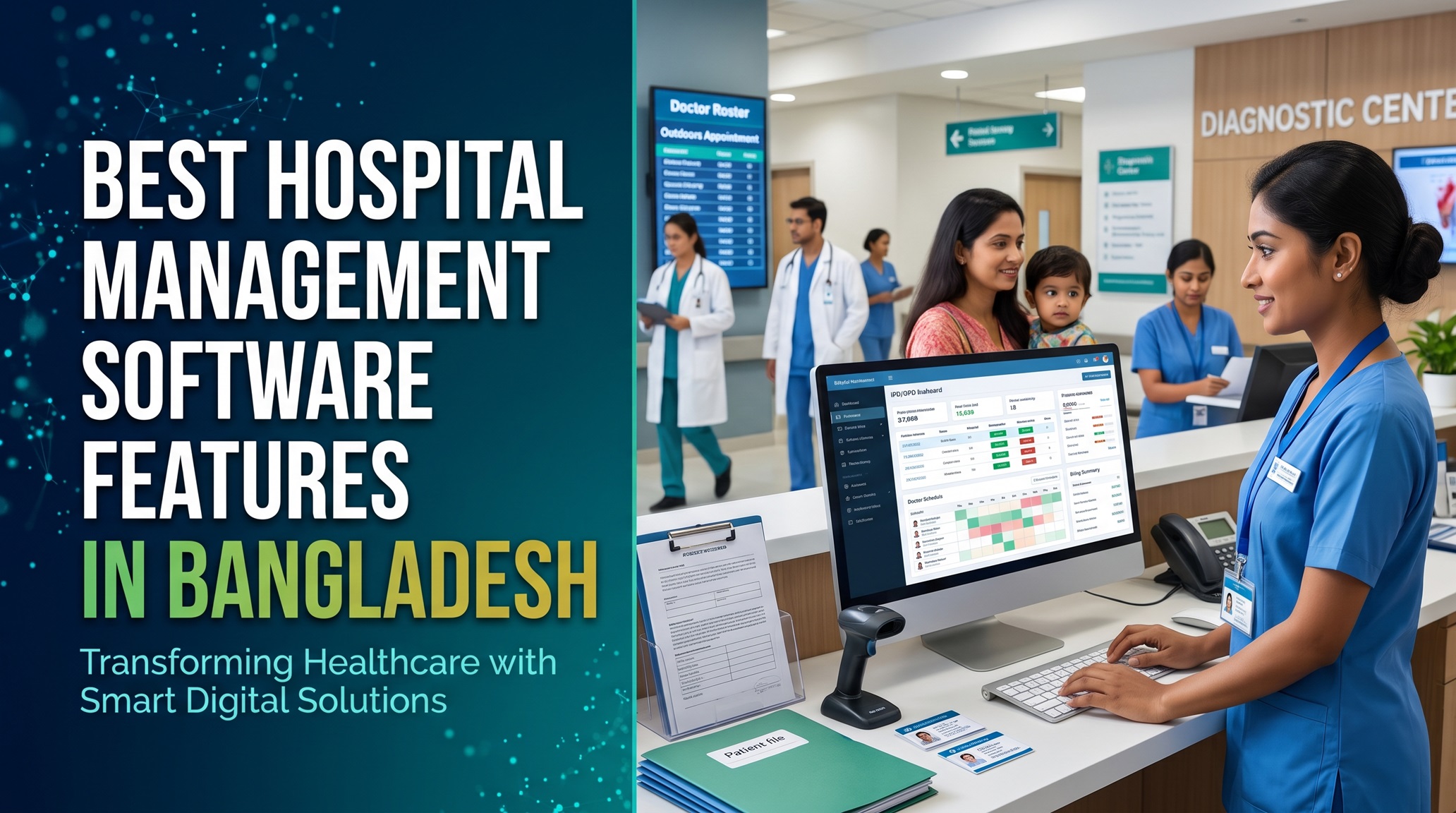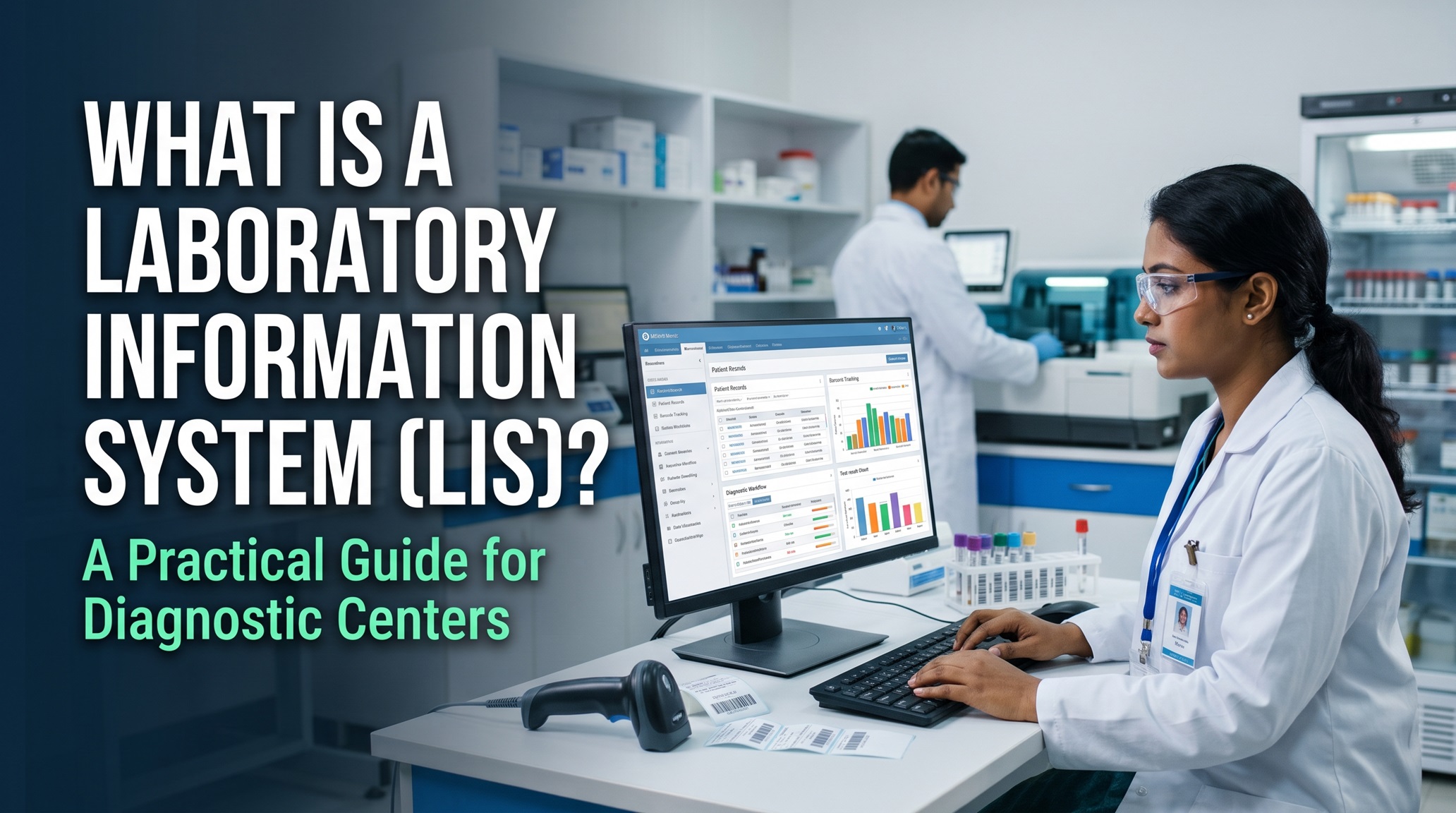
Diagnostic centers and hospital labs across Bangladesh handle hundreds of samples every day. Each one has to be collected from the right patient, labelled correctly, run on the right analyzer and turned into an accurate report, quickly, often while patients wait at the counter. When that work depends on handwritten registers and manual typing, mistakes and delays are almost guaranteed.
A Laboratory Information System (LIS) is the software that connects every step of that journey.
Key takeaways
- An LIS manages the full sample journey: registration, collection, barcoding, analysis, validation and reporting.
- Barcodes and analyzer interfacing remove most manual typing, which is where most lab errors begin.
- In Bangladesh, look for SMS report delivery, Bangla report support, offline tolerance during power cuts and local technical support.
- You can start small, with registration, barcoding and reports, and connect analyzers one by one.
The four stages an LIS manages
1. Sample collection and test ordering
Everything starts at the reception or collection desk. The patient is registered (or found by phone number in existing records), the requested tests are entered, and payment is recorded, whether cash, card, bKash or Nagad. A good LIS shows the right sample type and tube colour for each test, so the phlebotomist collects everything in one visit.
2. Barcoding and sample tracking
As soon as a sample is collected, the LIS prints a unique barcode label for the tube. From this point the barcode, not a handwritten name, identifies the sample. Scanning it at each step means you always know where a sample is and how long it has been waiting.
3. Analyzer integration
Modern hematology, biochemistry and immunoassay analyzers can exchange data with software. With analyzer interfacing, the machine reads the barcode, knows which tests to run and sends results straight back into the LIS. No retyping means fewer transcription errors and faster results.
4. Validation and reporting
Results are checked against reference ranges, and abnormal values are flagged automatically as high or low. A pathologist reviews and approves the report, which can then be printed, sent to the patient by SMS with a download link, emailed, or shared with the referring doctor.
Why diagnostic centers in Bangladesh are moving to an LIS
- Fewer errors: barcodes and analyzer interfacing remove most manual data entry.
- Shorter waiting times: staff spend less time on paperwork, and you can see exactly where delays happen.
- Happier patients and doctors: reports arrive sooner, by SMS, without a second trip to the center.
- Clear management data: daily sample counts, test volumes, collections by payment method and turnaround times, all in real time.
- Referral tracking: see which doctors and branches send which tests.
- Secure records: results are stored digitally with role-based access instead of in paper files.
LIS and hospital management software
In a hospital, the lab is one department among many. When the LIS is part of a complete hospital management system, test orders come directly from doctors in OPD or wards, billing happens automatically, and results appear in the patient's record without extra steps.
What to look for when choosing an LIS in Bangladesh
- Analyzer compatibility: confirm the system can interface with the machines you use today and those you plan to buy.
- Barcode support: label printing and scanning should be built in, not an add-on.
- Report formats: your reports should carry your branding, signatures, reference ranges and, if you need it, Bangla text.
- SMS and online delivery: patients increasingly expect reports on their phone.
- Works through power cuts: ask how the system behaves during load-shedding or an internet outage, and how data syncs afterwards.
- Local support: quick help in Bangla, in your working hours, matters more than a long feature list.
- Data security and backups: ask how data is protected, who can access it and how often it is backed up.
A practical implementation path
Moving to an LIS does not have to disrupt your lab. A typical, low-risk sequence:
- Registration and billing at the front desk.
- Barcode labels at the collection point.
- Result entry and report printing, with your existing formats.
- SMS report delivery to patients.
- Analyzer interfacing, one machine at a time, starting with the busiest.
- Dashboards for turnaround time and daily volumes.
Train staff in small groups and run both systems side by side for a short period before switching off paper registers.
Frequently asked questions
Is an LIS only for large hospitals?
No. Small and mid-sized diagnostic centers often benefit the most, because a few staff handle registration, collection and reporting together, and an LIS removes much of the repetitive typing.
Can an LIS work with the analyzers we already have?
Usually, yes. Most modern analyzers support data interfacing. Share your analyzer models with the software provider so they can confirm compatibility before you buy.
Can patients receive reports by SMS?
Yes. A good LIS sends an SMS when the report is ready, with a secure link to view or download it, so patients don't have to return to the center.
What happens during a power cut or internet outage?
That depends on the system design. Ask whether it runs on a local server, how it handles short outages and how data is protected. A UPS for the server and network equipment is strongly recommended.
Getting started
If you are planning to digitize your laboratory, talk to our team in Savar, Dhaka. We can show you a live demo of our Hospital Management & LIS Software using your own test list and report format.